A sharp, geopolitics-triggered shock on Friday cascaded into one of crypto’s largest deleveraging events, with more than $500bn wiped from market cap as forced liquidations surged, order book depth vanished, and venue-specific pricing frictions amplified stress, especially around Binance and USDe, leaving open interest suppressed despite a partial weekend rebound.
BTC longs wiped out as market plunges
Liquidity dried up as market makers stepped back
The role of Binance and Ethena’s USDe in the crash
Published on October 13, 2025. This content is from Kaiko's premium Data Debrief sent weekly. This includes in-depth analysis and exclusive charts leveraging Kaiko’s institutional grade data.
When October Surprise Meets Crypto Liquidity Drought
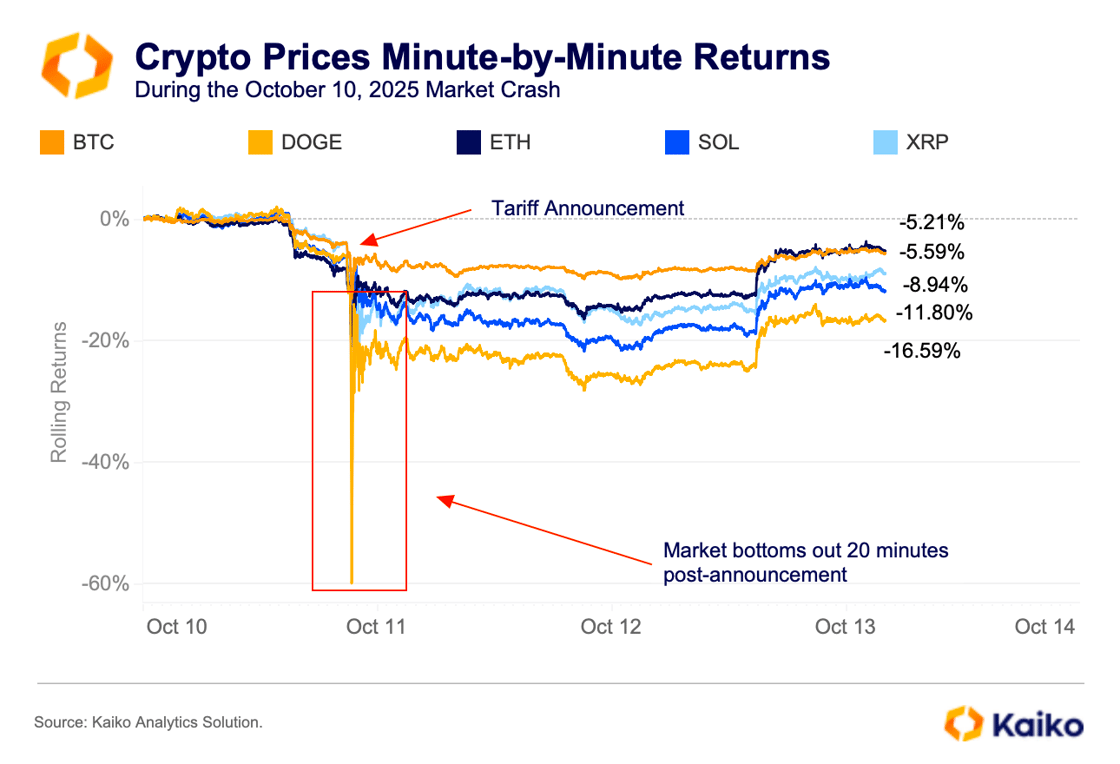
900 points erased from the Dow in a single session, the S&P 500’s worst day since April, and crypto fared even worse. A historic liquidation cascade ripped across digital assets on Friday, draining liquidity and driving leading coins down by nearly 60%.
Asset prices were already declining on Friday afternoon UTC, after President Trump threatened new tariffs on China in response to their additional restrictions on rare earth minerals.
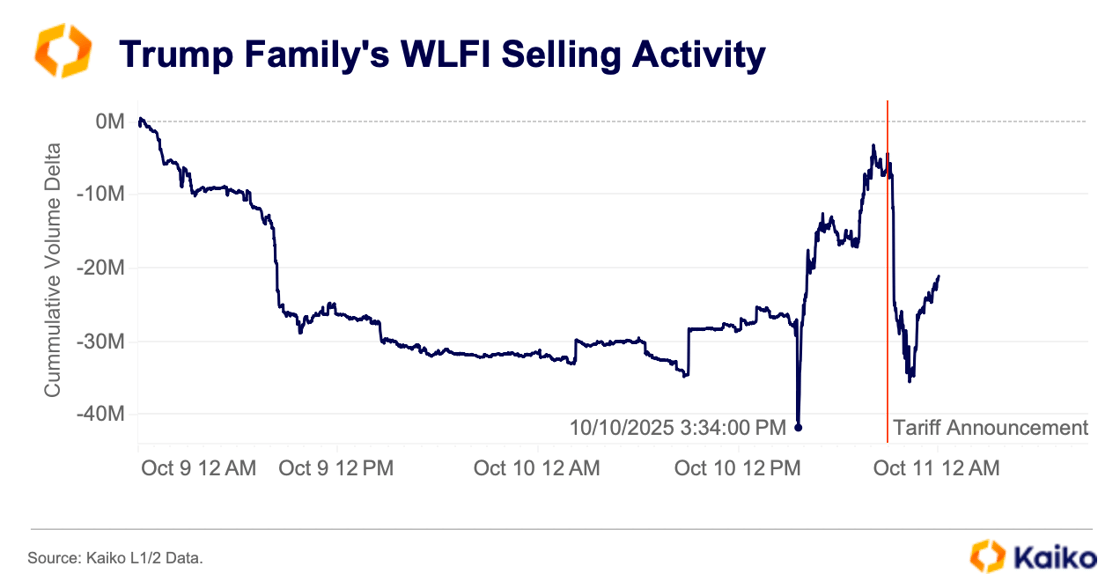
Interestingly, the token linked to the Trump family's crypto project, World Liberty Financial (WLFI), faced significant selling pressure late Thursday and throughout Friday morning, ahead of the announcement. WLFI’s cumulative volume delta bottomed out, indicating intense selling activity, around 3:34 pm.
Mass Liquidations
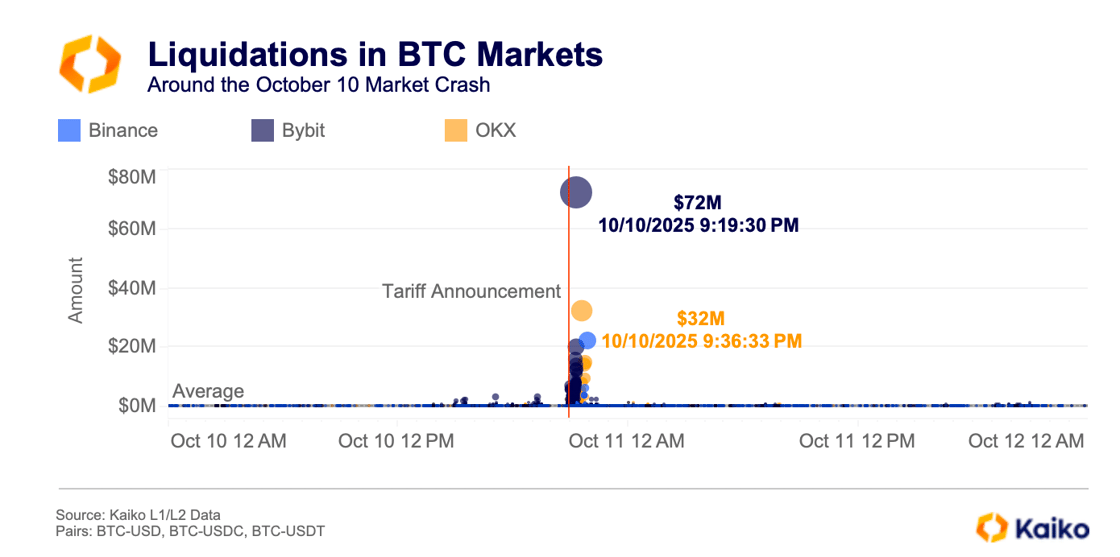
The rapid decline in prices triggered mass liquidations across both centralized and decentralized markets. Many traders suffered significant multi-million dollar losses on Friday, with the largest BTC long positions liquidated on Bybit and OKX for $72 million and $32 million, respectively.
These liquidation events came shortly after Trump’s tariff announcement, made around 8:57 pm UTC. By day’s end, roughly $2 billion in BTC positions alone had been liquidated across Binance, Bybit, and OKX. Naturally, long positions far outweighed shorts, as prices did not rebound until later in the weekend.
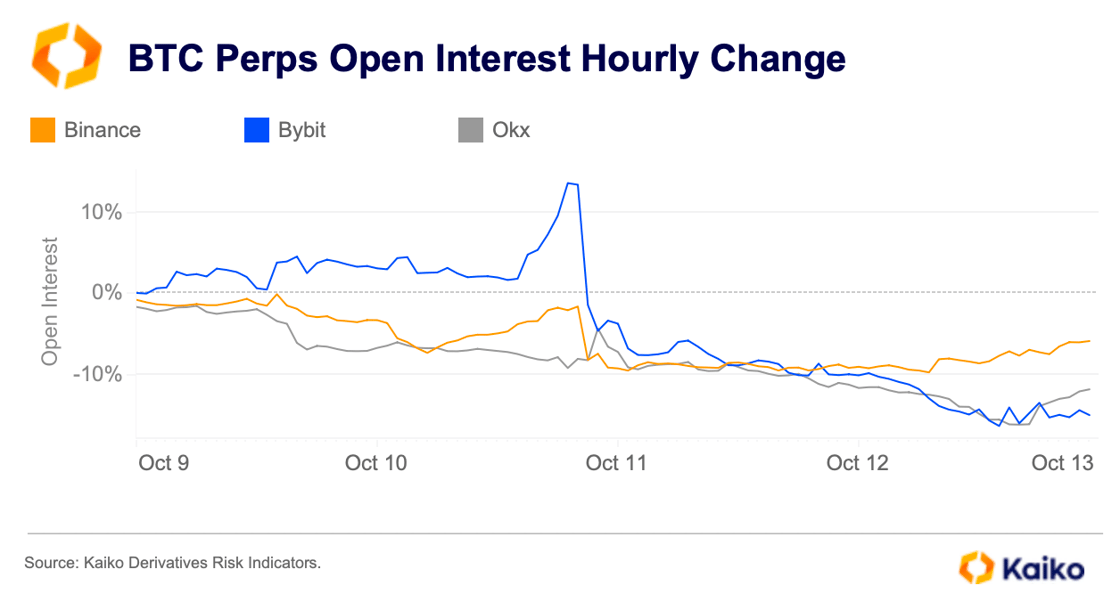
Looking at BTC perpetuals’ open interest, using changes in total contracts rather than dollar amounts to strip out the effect of price declines, we found that OI fell by more than 10% across major venues on Friday.
Open interest remained depressed throughout the weekend and has yet to recover from the shock, despite prices rising into Monday evening. This is likely due to several factors, with expectations of continued geopolitical volatility in the coming days being the most significant. It also underscores the extent of leverage present before the crash.
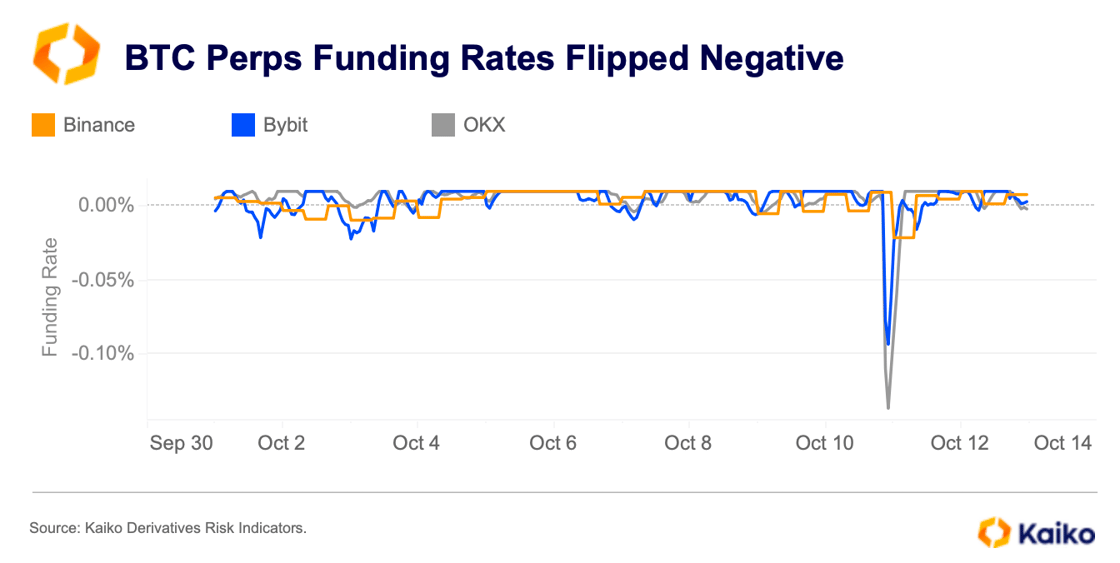
Elevated funding rates on some perpetuals venues pointed to excess leverage. The news, combined with structural issues on certain venues, helped trigger the massive liquidations and confirmed this assessment.
Market Makers Exodus
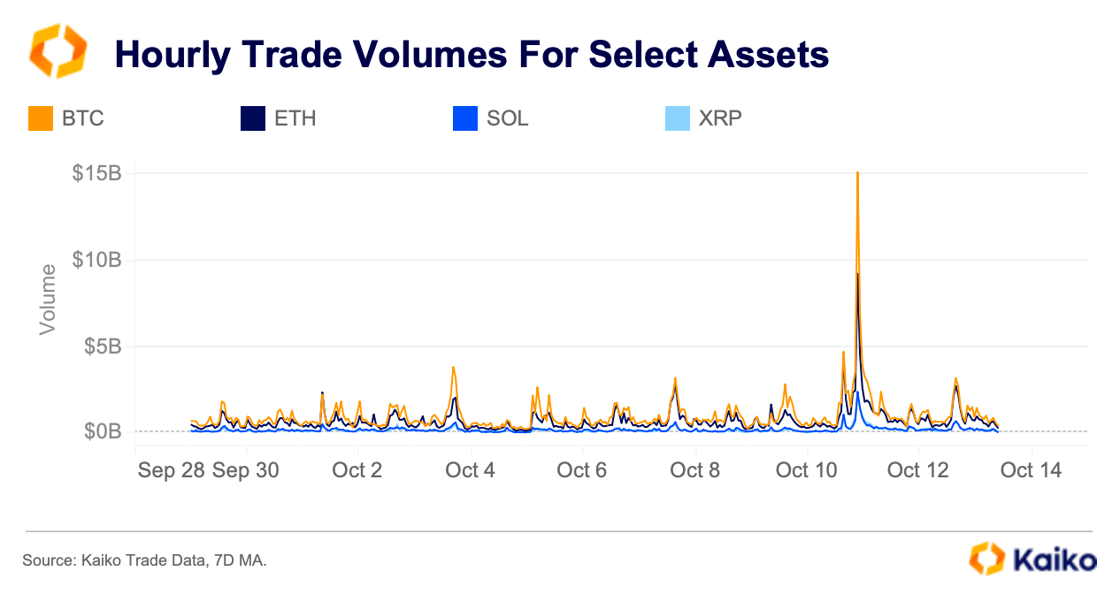
Volumes spiked on Friday as panic set in. BTC was the most traded Layer-1 asset, with more than $15 billion changing hands between 9 pm and 10 pm. ETH saw about $9 billion in volume during the same period, while SOL and XRP each recorded around $2 billion.
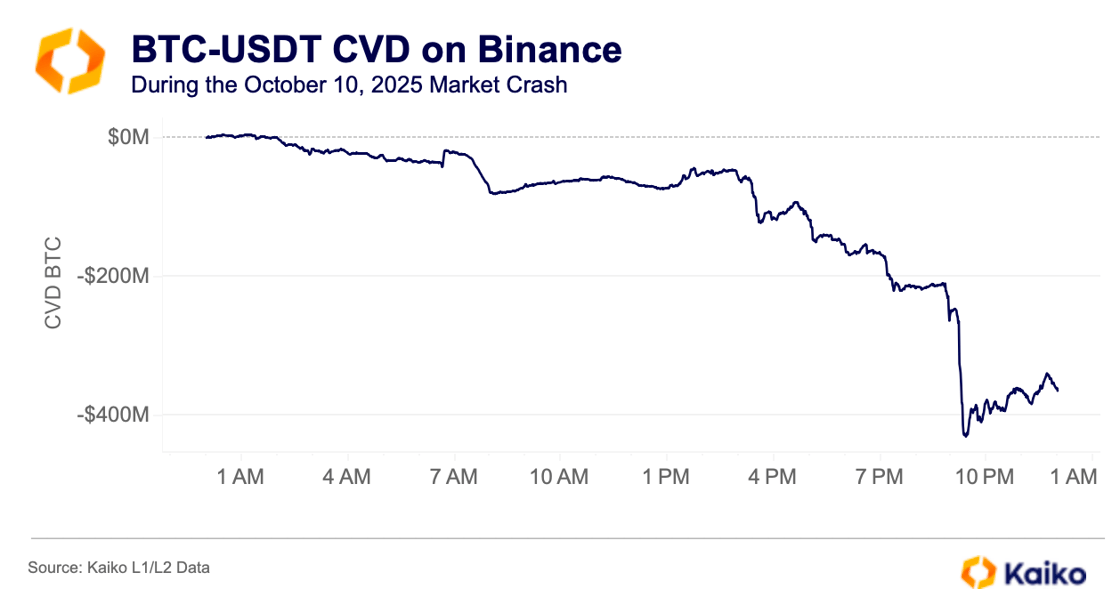
USDT was the most traded asset during Friday’s crash, reflecting its role as the deepest source of liquidity for most crypto pairs on Binance and other exchanges. On some markets, USDT-USD pairs even traded at a slight premium. Tick-level trades and cumulative volume delta show the scale of BTC selling into USDT during this window, with roughly $200 million sold between 9:12 pm and 9:24 pm.
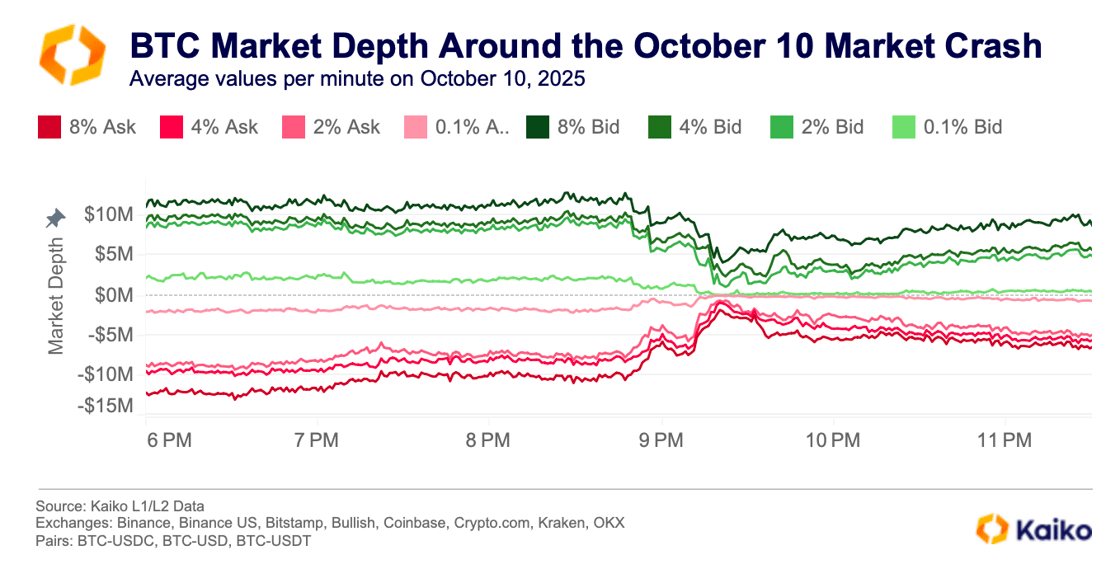
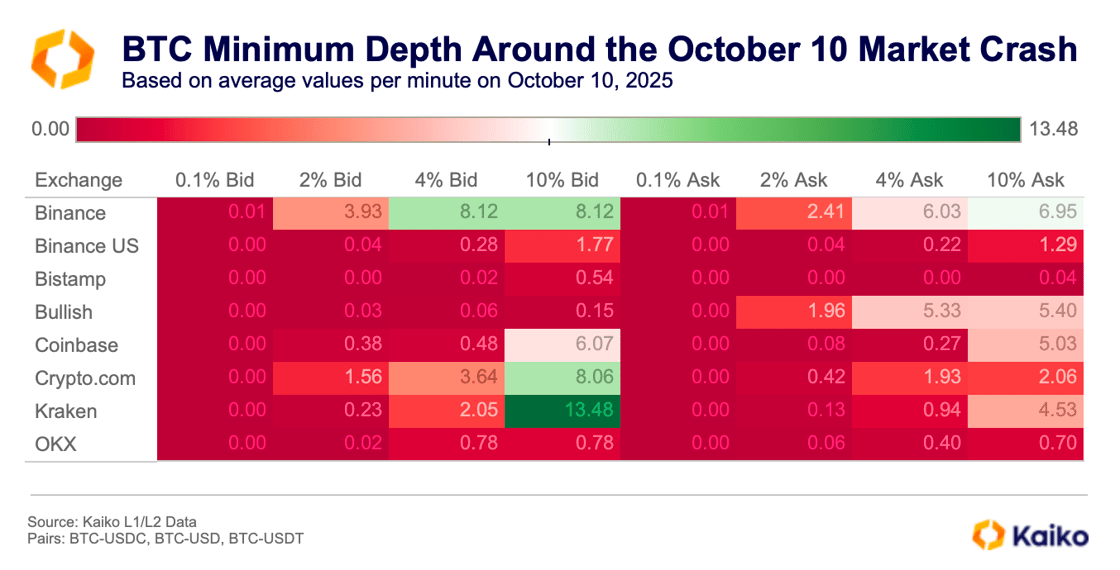
The flight to the most liquid pairs highlighted another problem during the crash: a severe lack of liquidity across BTC order books. There was a clear mismatch between volume and market depth, which typically signals a shortage of active market makers.
Zooming in on the data shows the full effect of the liquidity drought during the crash. On some exchanges, BTC liquidity was zero or near zero at every level. Only broader depths, such as bids 4% and 10% from the mid-price, had meaningful size on Binance, Crypto.com, and Kraken.
It is likely that heightened volatility and uncertainty made market makers less willing to take risk during this period, which in turn contributed to the decline.
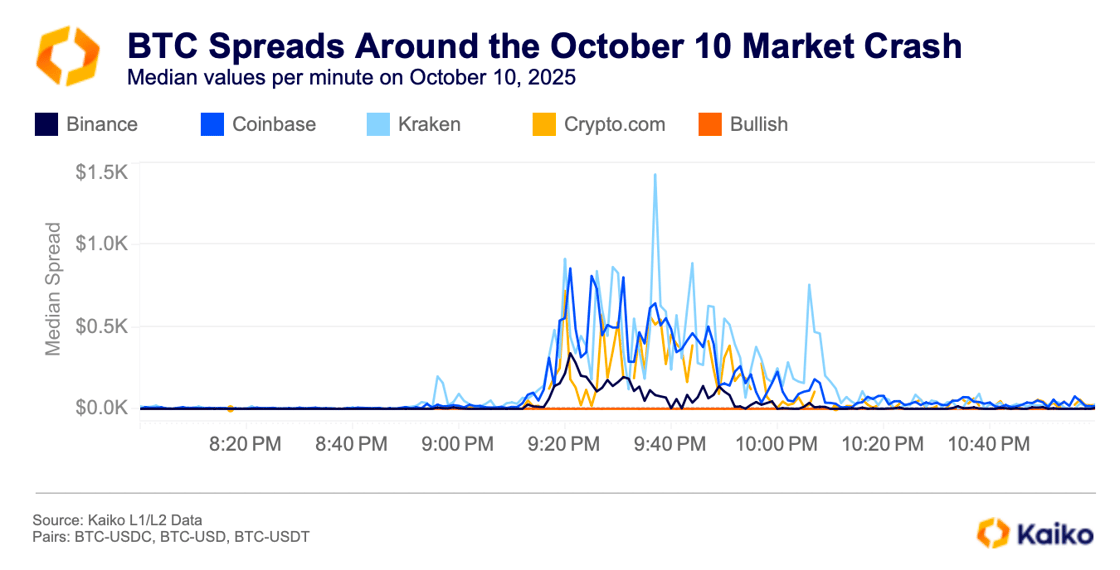
As a result, spreads widened sharply during the crash, spiking to as high as $1.5k on Kraken and between $500 and $1k on Coinbase and Crypto.com. Seeing spreads this wide on major venues reinforces the view that market makers pulled back during the turmoil.
Why were order books so inefficient during the crash? Volatility is nothing new in crypto, so it should not spook the market to this extent, and it likely was not just macro fears driving prices lower. Another event that underscored the uncertainty during the sell-off occurred on Binance’s derivatives market.
Binance, USDe, and Pricing Oracles
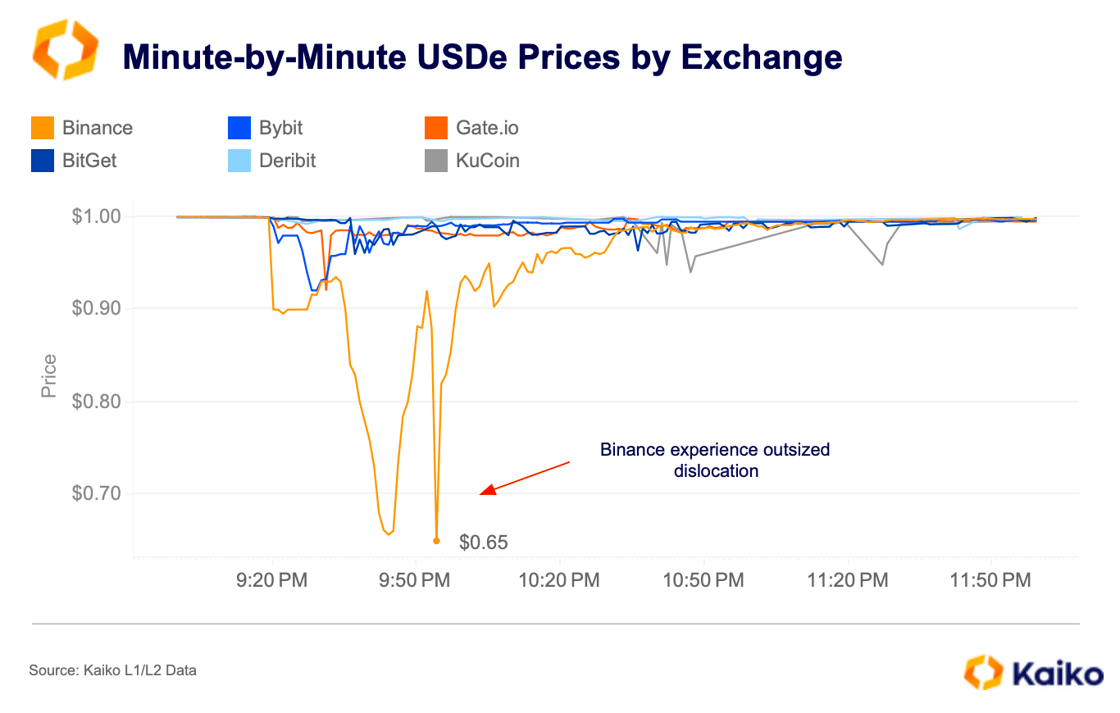
Before discussing the dislocation in USDe’s price on Binance, it is important to note that Ethena maintained mints and burns throughout the turmoil, ensuring USDe was always worth $1 in its primary market. However, during Friday’s uncertainty, USDe’s price briefly fell to $0.65 on Binance.
The dislocation on Binance’s spot market was an outlier. Although USDe was volatile during the crash, it did not trade below $0.90 on any other major venue.
As a result of this dislocation on Binance, derivatives contracts on the exchange were inaccurately priced. Although USDe was trading at or near its $1 peg on other exchanges, Binance’s spot market was used to price its derivatives products, which led to forced liquidations.
The core issue appears to be the pricing methodology. USDe’s price was based on its own spot market on Binance. Once that market dislocated, positions were pushed underwater, even though USDe remained redeemable for $1 throughout the turmoil.
We will discuss pricing mechanisms in derivatives products in a special edition report on Wednesday. In particular, we will examine how benchmark indices that pull prices from multiple venues can mitigate this type of risk.
This content is the property of Kaiko, its affiliates and licensors. Any use, reproduction or distribution is permitted only if ownership and source are expressly attributed to Kaiko. This content is for informational purposes only, does not constitute investment advice, and is not intended as an offer or solicitation for the purchase or sale of any financial instrument. For any questions, please email research@kaiko.com.
To manage your subscription with Kaiko Premium Research, cancel, or update your payment method, click here.
.png?upscale=true&width=1200&upscale=true&name=data%20debrief%20(2).png)